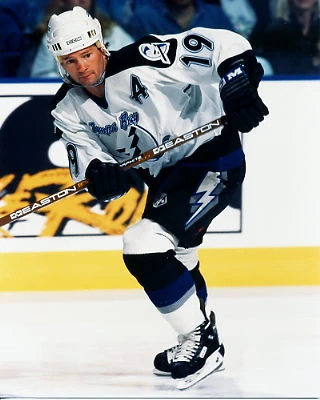
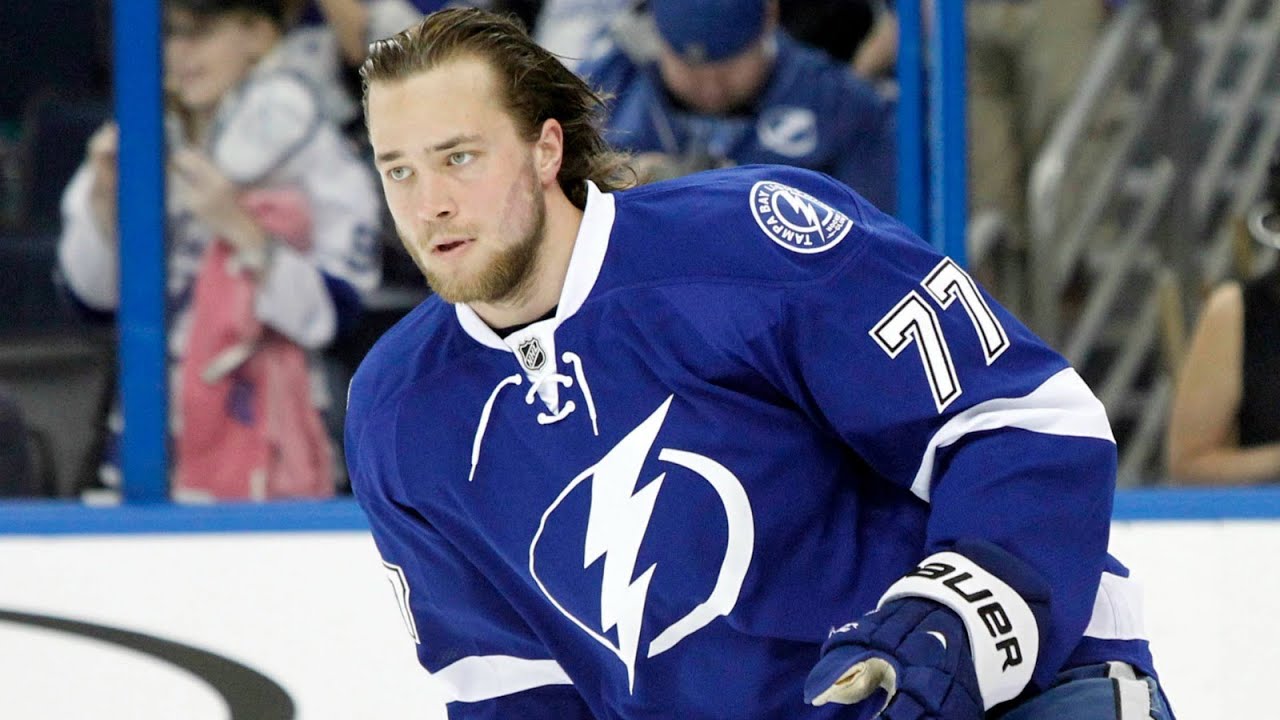
25 autumns ago the Tampa Bay Lightning took the ice for the first time, and there have obviously been many ups and downs since then.
With their 25th season now more than 25 percent complete, there are many ways I could commemorate the Bolts' 25th anniversary. I could do a post about their history in general; or one covering their 25 greatest moments; or one that covers their 10 highest points and 10 lowest points. I could do one about the greatest players in franchise history; or the greatest plays in franchise history; or the most overlooked moments in franchise history.
But I am choosing to do something a little different, because when it comes to hockey and my hometown team, I like to be a little different. Hockey is the most international of this continent's big four team sports, and in recognition of that fact, this post will recap the top three Lightning players from each of the countries that are widely considered to be hockey's "big six" powerhouses.
Because this is not intended to be a ranking of first-second-third, the players (and nations) are named in purely alphabetical order... although there are two cases where you will probably be thinking to yourself, "Hey, John clearly thinks this guy is a cut below the other two!"
And here we go.
CANADA
Because so many Canadians populate NHL rosters, a list like this makes it almost unfair to limit a team's allotment to just three. As of two years ago (the most recent tabulation I could find), 48.6 percent of NHL'ers hailed from The Great White North, with the other 51.4 percent divided between more than ten different countries. For the Bolts, my "three from each" approach means stars such as Brad Richards, Dave Andreychuk, Dan Boyle, Brian Bradley, and Daren Puppa are getting left off the list... but I'm sticking with the approach nonetheless, and as I see it, Tampa Bay's top troika of Canucks is as follows.
Vincent Lecavalier
Vinny Lecavalier (to this day fans refer to him simply as Vinny, no last name needed) was drafted by the Lightning with the first pick of the 1998 draft and remained with them all the way to 2013. He helped lead them to Stanley Cup glory in 2004 and to the conference finals in 2011. He ranks as their all-time leader in goals, even-strength goals, and games played; and second all-time leader in assists, points, game-winning goals, power play goals, and goals created (go here if you care to read how that stat is calculated).
Lecavalier won the Rocket Richard Trophy by leading the NHL in goals for the 2006-07 season; won the NHL Foundation Player Award in 2008; captained the Eastern Conference All-Star Team in 2008; and not to be forgotten, during the same year he helped the Bolts win the Stanley Cup, he was also the MVP of the World Cup of Hockey.
His double overtime goal in Game Three of the opening round of the 2003 playoffs kept the Lightning from falling into a 3-0 series hole against Washington, after which they proceeded to take that series and advance to the second round for the first time in history. His 2004 'tween-the-legs redirect of Andreychuk's shot, with 16.5 seconds left in regulation of Game Three against Montreal, is arguably the best goal in franchise history when you consider its difficulty, timeliness, and the fact it forced the game to overtime where the Bolts prevailed en route to sweeping that series and eventually winning the Cup.
And I haven't even mentioned the millions of dollars and countless hours of time Lecavalier has donated to start and sustain a center for pediatric cancer and blood disorders at All Children's Hospital, proving himself a community pillar of the first degree.
Martin St. Louis
The other all-world Quebecker from that Stanley Cup squad, Martin St. Louis, enjoyed a long run here from 2000 to 2014 that was almost entirely concurrent with Lecavalier's. St. Louis ranks as the Bolts' all-time leader in points, assists, game-winning goals, short-handed goals, hat tricks, and goals created; and second all-time in both goals and even-strength goals.
He led the NHL in points for the 2003-04 season and did it again in 2012-13, making him the oldest player to accomplish that feat (he was 37 compared to Wayne Gretzky doing it at 33) and also making him just the second player to do it nine seasons apart. In 2004 St. Louis won the Hart Memorial Trophy as the league's most valuable player, plus the Lester B. Pearson Award for the league's most outstanding player as voted by the players. He also won the Lady Byng Memorial Trophy (for "sportsmanship and gentlemanly conduct combined with a high standard of playing ability") on three separate occasions.
In triple overtime of Game Six against Washington in 2003, he scored the goal which delivered the first playoff series victory in franchise history. Then, in double overtime of Game Six against Calgary in 2004, he scored what is arguably the most important goal in franchise history -- forcing the Stanley Cup Final to Game Seven, which, as we all know, the Bolts wound up winning.
On January 13th of this year, St. Louis became the first player in Lightning history to have his number retired: An honor well-deserved by the undersized dynamo whose #26 now hangs from the rafters forever.
Steven Stamkos
He is only 27 and still in his prime, but that doesn't matter because Steven Stamkos absolutely belongs on this list. He has won the Rocket Richard Trophy twice, and over the last nine seasons is the only player in the NHL to record a 60-goal season. He has already passed the 600-point mark, and with 624 points in 616 games played he has done so at a greater than point-per-game pace. Stamkos holds the franchise records for most goals in a season and highest goals-per-game average in a career; and despite his youth he holds the franchise record for most power play goals in a career and is tied with Martin St. Louis for most hat tricks in a career.
But as outstanding as all of that is, the most tremendous thing so far in Stamkos's career is the simple fact that he inked a new contract with the Bolts last June when he was days away from becoming the highest profile player to hit the free agent market in years. Heavy hitting franchises from "traditional" and "big" markets were lining up to open their Brinks trucks and lure him to their cities. The richest franchise on Earth, the Toronto Maple Leafs, sought to make Stamkos the face of their team and the hockey savior of a city that proclaims itself the hockey capitol of the world. Their pitch was aided by appeals from Toronto's mayor himself and by the CEO of Canadian Tire, who promised bazillions in endorsement dollars in the event Stammer chose to take his skills to Canada's biggest metropolis.
Stammer, however, had other ideas. He opted to remain right here, and in order for the Bolts to remain a serious Cup contender (i.e., in order for them to be able to keep other big time players on the roster without exceeding the salary cap) he signed an eight-year contract that pays him at least a couple million dollars less per year than he could have gotten from another organization on the open market. For that, he instantly earned the title of GBE -- Greatest Bolt Ever -- even though his Bolts story is far from over.
CZECH REPUBLIC
This country churns out world class hockey players by the bushel, and the number of them who have played for the Lightning is so big that the names I had to leave off this list are surprising. How can I not include the stalwart Ondrej Palat? How can I not include Roman Hamrlik, the first draft pick in team history, whose 65-point campaign in 1995-96 remained the highest-scoring season by a Tampa Bay defenseman for 21 years? Well, this is how...
Petr Klima
Brian Bradley was the Bolts' first all-around offensive star, but Petr Klima was their first true sniper. His 15.5 shooting percentage during his four years in Tampa Bay is the second-highest career shooting percentage in team history, trailing only Stamkos and sitting 0.3 ahead of Nikita Kucherov Himself (whose to-date career is also four years).
Klima had already made hockey history before he joined the Lightning in 1993. Eight years previously, at the age of 20, he defected from communist Czechoslovakia by sneaking away from the Czech National Team while it was in West Germany and rendezvousing with Detroit Red Wings VP Jim Lite and assistant coach Nick Polano. They secreted him from city to city for several days to elude Czech police until they could get him on a plane and fly him to America. After four successful seasons with the Wings he was traded to Edmonton during the 1989-90 season, and went on to score one of the most famous goals in NHL history when he beat Boston goalie Andy Moog through the five hole 15 minutes into triple overtime to win Game One of the Stanley Cup Finals.
On March 27, 1995 -- four years to the day before I wed the lovely Erika -- I sat in the Thunderdome and watched Klima take a perfect outlet pass from Brian Bradley halfway through overtime, race all alone into the offensive zone, and flip the puck past Patrick Roy to give the Bolts a 3-2 win over the stinkin' Habs. Thirteen months later, in the first NHL playoff game I ever attended, he blasted a slap shot from the high slot that scorched the ice and banged into the net behind a Ron Hextall who had no chance. Petr Klima was a bright spot during this franchise's early and heady days.
Pavel Kubina
The Lightning went through a dispiriting down period in the late 1990's before rising to Stanley Cup prominence in the first half of the 2000's. Although forwards like Lecavalier, St. Louis, and Richards are universally remembered for leading the team out of the weeds and to the top of the peak, this feisty defenseman from a 400-year-old village in the shadow of the Moravian-Silesian Beskid Mountains deserves to have his name remembered just as universally as theirs.
By giving the Lightning an imposing force on the blue line, Pavel Kubina afforded their budding forwards the freedom to take the necessary risks to develop into offensive stars, and with his speed and hockey smarts he contributed mightily to the offense as well. Take a look at the franchise's record book and you will see that Kubina ranks fifth all-time in shots and in the top ten in assists, game-winning goals, power play goals, and short-handed goals. Plus, he ranks third in games played, trailing only Lecavalier and St. Louis. And lest the flurry of offense-related rankings mislead you into assuming Kubina was a soft, offense-minded defenseman, don't forget that he ranks second all-time in penalty minutes!
He is an automotive buff, and since retiring from the game that made him rich, he has simultaneously indulged his hobby and contributed to our local economy by opening Private Allstar Cars in Largo. Though born behind the Iron Curtain, he is now a Bay Area Man through and through.
Vaclav "Vinny" Prospal
I have no idea why people insisted on giving Vaclav Prospal the non-Czech-sounding nickname Vinny. Maybe they thought Vaclav sounds too much like a vampire. Maybe they just liked the way "Vinny Prospal" sounds. Or maybe they liked the idea of saying "Vinny passes to Vinny," since Prospal spent much of his time playing on Lecavalier's left wing.
At the end of the day, who cares why people started calling him Vinny? All that matters is that he was a productive Bolt who was proud to be a Bolt and loved every minute of the years he plied his trade while wearing a Tampa Bay Lightning sweater.
Though he played less than six full seasons with the team, Prospal ranks fifth in franchise history in total points (52 ahead of the man behind him); fifth in goals created; sixth in assists; and seventh in both goals and even-strength goals. Gotta love him.
FINLAND
When you consider how many hockey players hail from Finland, it's surprising how few Finnish stars have suited up for the Lightning. But that does not mean we've had no good ones over the years.
Sean Bergenheim
Although he played here for only one campaign (2010-11), Bergenheim was such a standout during that campaign's post-season that he will always hold a special place in the hearts of Lightning fans. Despite playing on the third line, he led those Bolts with nine playoff goals -- all at even strength -- including the lone score in their 1-0 Game Seven victory over the Penguins. He and Dominic Moore clicked with a maneuver in which Bergenheim would skate/drift into the right circle and Moore would feed him with a no-look pass from below the goal line, which he routinely converted by snapping the puck past goalies who had no time to discern what was happening.
Unfortunately, after sustaining a still-undisclosed lower body injury in the Eastern Conference Finals, Bergenheim missed most of Game Four and all of Games Six and Seven. The Bolts lost that series by a single Game Seven goal, and many people will always believe that our team would have prevailed in that series and perhaps won the Cup had he not been sidelined down the stretch.
Valtteri Filppula
This even-keeled and genuinely vampire-looking native of the city of Vantaa played a major role in returning the Lightning to contender status this decade. A slick passer with a crisp shot and knack for scoring at key times, his career shooting percentage with the Lightning is in the top ten and higher even than Lecavalier's and Andreychuk's.
However, Filppulla is best known for doing All The Little Things that are crucial to winning but don't show up on the stat sheet, things like poking the puck away from opposing forwards, deflecting opposing shots, chipping opposing passes off course, and winning puck battles along the boards. Filppula was above 50% in face-offs for three of his four seasons here and contributed 22 playoff points versus only four playoff penalty minutes. You could not compile a wished-for hockey roster without including a player like him.
Sami Salo
Much like Sean Bergenheim, this skilled defenseman did not spend anywhere near the lion's share of his pro career in Tampa Bay. Salo was 37 when he signed with the Bolts and wound up playing here for only the final two of his fifteen years in the NHL. Nonetheless, he had a significant impact because his reliable, two-way play solidified the Bolts' back end and returned them to the playoffs as they transitioned into a new era that could no longer include Lecavalier and St. Louis. Despite injuries, Salo played 73 games (regular season and playoffs combined) in his final season and opted to retire 19 days before his 40th birthday.
RUSSIA
Two of the following players from the Land of the Firebird are no-brainers. Deciding who to tap for the third spot proved taxing, however. Here we go...
Nikolai Khabibulin
There was a span of time when Nikolai Ivanovich Khabibulin was arguably the best goaltender on Planet Earth, and fortunately for us, that was when he was wore the Lightning's sweater. While a member of the Bolts he also played for Team Russia at the 2002 Olympics and was named the best goaltender of those games. In 2004 he delivered Lord Stanley's Cup to our city(ies) by the bay with a stellar post-season during which he pitched five shutouts, recorded a .933 save percentage, and allowed opposing teams to score just 1.71 goals per game.
Khabibulin's performance in Game Four of the Stanley Cup Finals is, in my not-so-humble opinion, the best game ever played by a Tampa Bay netminder: After Brad Richards scored less than three minutes into the game, Khabibulin made the 1-0 lead hold up the rest of the night against a Calgary Flames onslaught that peaked in the final period when they outshot the Lightning 12-5. Turns out they called him "the Buhlin wall" with good reason.
Nikita Kucherov
Yes, he is only 24, but he is the best shooter currently playing in the NHL and is already one of the greatest players in franchise history.
A lefty born less than 90 miles from the Black Sea, Nikita Kucherov has the quickest release I have ever seen and expertly deceives opponents in multiple ways. He is deadly on both the forehand and backhand; is a premier passer as well as a premier shooter; and also plays sound defense. And he does not hesitate to battle for pucks in the corners or to bow up and physically challenge opponents who are trying to push people around.
Kucherov's goal and point production has increased every year he has been in the league, from 9/18 to 29/65 to to 30/66 to 40/85 -- and so far this season, a mere 30 games in, he has already racked up 42 points via 21 goals and 21 assists.
And, the man they call Kuch has made his mark not just in the regular season but also in the post-season, thus far having notched 42 points in 45 playoff games while going plus-20. His long-distance overtime rocket past Henrik Lundqvist in Game Three of the 2015 Eastern Conference Finals is forever etched in Lightning lore -- as are his stick blade redirect past Corey Crawford in Game Two of that year's Stanley Cup Finals, and the fact of him scoring late goals to force OT in both Game Three and Game Four of their 2016 series against the Islanders, with 0:38 and 3:16 left on the clock, respectively.
Alexander Selivanov
This Moscow native is sure to be the most controversial inclusion on this list because his tenure here was so mercurial. His valleys often seemed deeper than his peaks seemed high, and there are many people who accuse him of not living up to his potential. Given the trajectory of the current season, there is at least one Russian presently playing for the Bolts who would stand a good chance of replacing Selivanov on this list if I were to compile it next year. However, I am compiling it today, based on what has already happened up to now, and Selly deserves to be recognized.
Alexander Selivanov had a wrist shot so wicked that some goalies still haven't seen pucks that blew by them them off his stick. He arrived on our shores 23 years ago, as a 23-year-old who had never traveled overseas and whose English was very limited. He had a ho-hum rookie season with 16 points and a minus-8 in 43 games, but his sophomore campaign (1995-96) was his breakout season and also the first one in which the Lightning made the playoffs. One of the most-forgotten facts in Lightning history is that Selivanov led that first playoff club in goals by a considerable margin, finishing with eight more than Brian Bradley and nine more than Petr Klima. In the franchise's first ever home playoff game, he scored the winning goal 2:04 into overtime by banging a rebound through the legs of Philadelphia's Ron Hextall.
If you want to focus on Selivanov's slumps, that is your right, and if you want to focus on him sometimes seeming to struggle in the communication and maturity departments, that too is your right. Nevetheless, you cannot write about the good times in Lightning history without writing about good things he did as a player, and I have to ask: When was the last time you moved to a foreign country where you didn't really know the language, and as soon as you arrived in that country you worked in a job where the public could watch and could constantly criticize your every move?
SWEDEN
Sweden needs no introduction as a hockey power, and these three Swedes should need no introduction as hockey players.
Victor Hedman
Now in his ninth season -- and still only 26! -- this Thor-looking man is the best defenseman in team history. For years now he has been called on to defend against the best forwards that every opponent has to offer, and has routinely come out on top. Victor Hedman is a Norris Trophy finalist for a reason.
However, his two-way game is so outstanding that people whose hockey knowledge comes mostly from highlights might not even realize he's a defenseman. Hedman excels not merely in hunkering down in the defensive zone, but in turning the action in the other direction and triggering offensive rushes. He does this with pinpoint outlet passes, and by turning on his jets and carrying the puck downstream like a point guard. He quarterbacks the play in the offensive zone with such effectiveness that, in spite of his job title, he ranks fifth in Lightning history in assists (252) and sixth in points (319).
In other words, Victor Hedman lives by that famous axiom that the best defense is a good offense. Perhaps the best example of this came in the second round of the 2016 playoffs, when the Lightning went up against the New York Islanders and their all-world centerman John Tavares. Back in the 2009 draft the Isles had taken Tavares with the top overall pick while the Bolts took Hedman second overall. When they met in that second round playoff series, the two players were regularly matched against each other and Tampa Bay's Swede was superior to New York's Ontarian. Tavares scored in the second period of Game One, and from that moment forward managed neither a goal nor an assist for the remainder of the series, whereas Hedman rang up eight points including the series-winning goal.
Fredrik Modin
In my 2014 post celebrating the 10th anniversary of the Lightning's first Stanley Cup, I wrote: "With a lumberjack's work ethic and an uncanny nose for the puck, Fredrik Modin was the prototypical Swede. It was he who scored the winning goal in Game Seven of the Eastern Conference Finals, and it is worth noting that two years later he helped lead Team Sweden to its first gold medal of the Oympics' 'NHL Era.'"
I wish I was always that succinct, but I'm not, and today I feel compelled to add that Modin was both productive and responsible at every spot on the ice, offensively and defensively, able to outrace you in a speed game or outmuscle you in a chippy one, whatever the situation required. He ranks sixth in team history in shots, fourth in even-strength goals, and fifth in total goals. When he represented the Bolts at the 2001 All-Star Game, he won the Hardest Shot Competition with a blast that registered at 102.1 mph.
And since we are talking about greatness, I also have to point out that Modin is one of only 27 people in the Triple Gold Club -- which is to say that he is one of only 27 people in all of history, from all the nations of the globe, to have won a Stanley Cup and Olympic gold medal and World Championship gold medal. Select company, indeed.
Anton Stralman
After the 2015 Stanley Cup Finals ended with the upstart Lightning having come up just short against the dynastic Blackhawks, ESPN's Craig Custance wrote this about Anton Stralman: "The 28-year-old defenseman finally found a team that appreciates his subtle game. With Hedman, he teamed up to form a duo that effectively shut down the Blackhawks' biggest stars in this series when they were on the ice against them. The only problem was, they couldn't always be on the ice."
That might be the best brief summary ever written of Stralman's play, for which "subtle" is definitely the perfect adjective. Stralman might not have the blinding speed of Erik Karlsson, but he is quick on the puck and never gets caught out of position. He is smallish and might not deliver hits with the brute force of Radko Gudas, but he is strong as hell and knocks opponents off the puck while rarely getting knocked off it himself. He does not engage in dirty play like Duncan Keith, but he backchecks and battles along the boards with piss and vinegar.
Stralman's hockey IQ is through the roof and he does not hesitate to mentor younger players -- as evidenced by how he has aided in this season's startlingly rapid development of 19-year-old Mikael Sergachev, who has scored the game-winning goal in four of the Lightning's 22 victories to date.
Simply put, Anton Stralman is a hockey player's hockey player and company man's company man. Every team in the league would love to have him on its roster, and we are very fortunate he is on ours.
UNITED STATES
God bless America, land that I love! Yes, my own country -- from the mountains to the prairies to the oceans white with foam -- has also produced some stellar performers for my Tampa Bay Lightning.
Ben Bishop
Colorado-born and Missouri-raised, Ben Bishop made it to the pros after a solid NCAA career at the University of Maine. The Lightning acquired him by trade in 2013 and his impact was immediate, as he backstopped them to the playoffs after a two-season absence. Bishop ranks as the franchise's all-time leader in literally every single goaltending stat there is: save percentage, goals-against average, saves, shutouts, wins, and wins in a season.
His positive effect cannot be overstated. As a money goaltender, he contributed to the team's offensive growth by making his teammates confident about taking risks on offense, secure in their knowledge that he could bail them out if things went wrong. He is the best puck-handling goalie of his generation (sorry Mike Smith) and used that skill to turn the tables by directing pucks in what opponents would call the "wrong" direction, feeding outlet passes to teammates to start offensive rushes. After all, opponents can't shoot if it's you instead of they who is controlling the vulcanized rubber.
Unlike Nikolai Khabibulin, Ben Bishop never won a Stanley Cup while playing in Tampa Bay, but he was a two-time Vezina finalist and his excellence absolutely extended to the post-season. He got the Bolts to the Eastern Conference Finals twice and Stanley Cup Finals once and went 3-1 in games in which the Bolts faced elimination (injury caused him to miss the 2014 Montreal series and 2016 Pittsburgh series). In 2015 Bishop became only the third goalie in NHL history to pitch two Game Seven shutouts in one post-season, the others being Patrick Roy and Tim Thomas. That same year, during the Eastern Conference Finals against the New York Rangers, he became the only goalie in NHL history to shut the Rangers out in back to back playoff games at Madison Square Garden.
The Lightning made the right business decision when they traded him after four years and handed the goaltending keys over to the much younger and equally talented Andrei Vasilevskiy, but still, it will feel a little strange if they win the Cup at some point in the next few years and Ben Bishop's name doesn't get engraved on it with them.
Ryan Callahan
Ryan Callahan's name, like Alexander Selivanov's, will generate some controversy by appearing on this list. My first impulse was to include not Callahan but Brian Boyle, due largely to the latter's clutch playoff performances and face-off expertise. A strong case could also be made for Shaun Chambers, the Bolts' best "defensive defenseman" in their fledgling years. But hear me out.
The main argument against our current assistant captain is that he missed most of last season (due to having his second hip surgery in eight months), and the season before that he was noticeably slowed by injuries that included a right hip labral tear. As a result, recency bias works against him because some people can't get past the thought of a man being largely invisible on the ice for two years while being paid an annual salary of $5.8 million.
But think about this: The main reason Bran Boyle played for Tampa Bay from 2014 to 2017, a stretch during which he made a huge impact in two deep playoff runs, is that Callahan reached out to him and convinced him to sign with the Bolts as a free agent. And even more significantly, Callahan also convinced Anton Stralman to come here as a free agent, and as we all know Stralman is now indispensable. This means that two key cogs in the Lightning machine that has been so successful this decade might never have played here if not for Callahan.
And by the way, Cally's on-ice game is far from shabby. Like the aforementioned Valtteri Filppulla, he is an All The Little Things kind of player who makes life difficult for opponents, and on top of that he brings an extra punch of derring-do by never hesitating to sacrifice his body to block a shot. In fact, he was such a shot-blocking machine in the 2015 playoffs, including the SCF, that if only one or two more Bolts had done the same it probably would have been the Bolts rather than the Blackhawks who ended up drinking from the chalice. Plus, if you think stuff that shows up statistically is supremely important, don't forget that Callahan rang up 54 points in the last full season he completed (2014-15).
Tyler Johnson
The 5'9" spark plug from Spokane made a splash as soon as he arrived, tallying 50 points in his first season and finishing third in the voting for the 2014 Calder Memorial Trophy (aka, NHL Rookie of the Year). One year later, he had arguably the best post-season of any player in the NHL during the Bolts' deep run to the SCF.
Tyler Johnson's 23 points in 26 playoff games led the league in 2015, as did his 13 playoff goals. One of the highlights from that run was his OT winner in Game Two against Detroit, which he potted after scoring one goal and assisting on anther in the final five minutes of regulation to erase a two-goal deficit and force overtime. Other highlights include the winner against Montreal with 1.1 seconds remaining in Game Three, and a natural hat trick against the New York Rangers in Game Two of the conference finals.
And Johnson is no one-year wonder, as evidenced by him churning out 17 points in 17 playoff games the following season, when the Bolts pushed the eventual Cup-winners all the way to the seventh game of the Eastern Conference Finals. Thus far in his Lightning career, Johnson has played in 47 playoff contests and accounted for 42 playoff points on a perfectly even 21 goals and 21 assists.
But all that is "just" playoffs. Overall, Johnson already ranks in the team's all-time top ten in goals, short-handed goals, hat tricks, goals per game, points per game, and goals created -- and in the top five in game-winning goals and plus/minus. No wonder the team recently signed him to a seven-year extension!
Well, that's it for now. It will be interesting to do this again a quarter-century from now and see how many of these guys are still on the list after the organization turns 50. Until next time: Au revoir!